White Peacock 012 | L'Infini: The Life Watershed of Releasing Judgment and Embracing Freedom
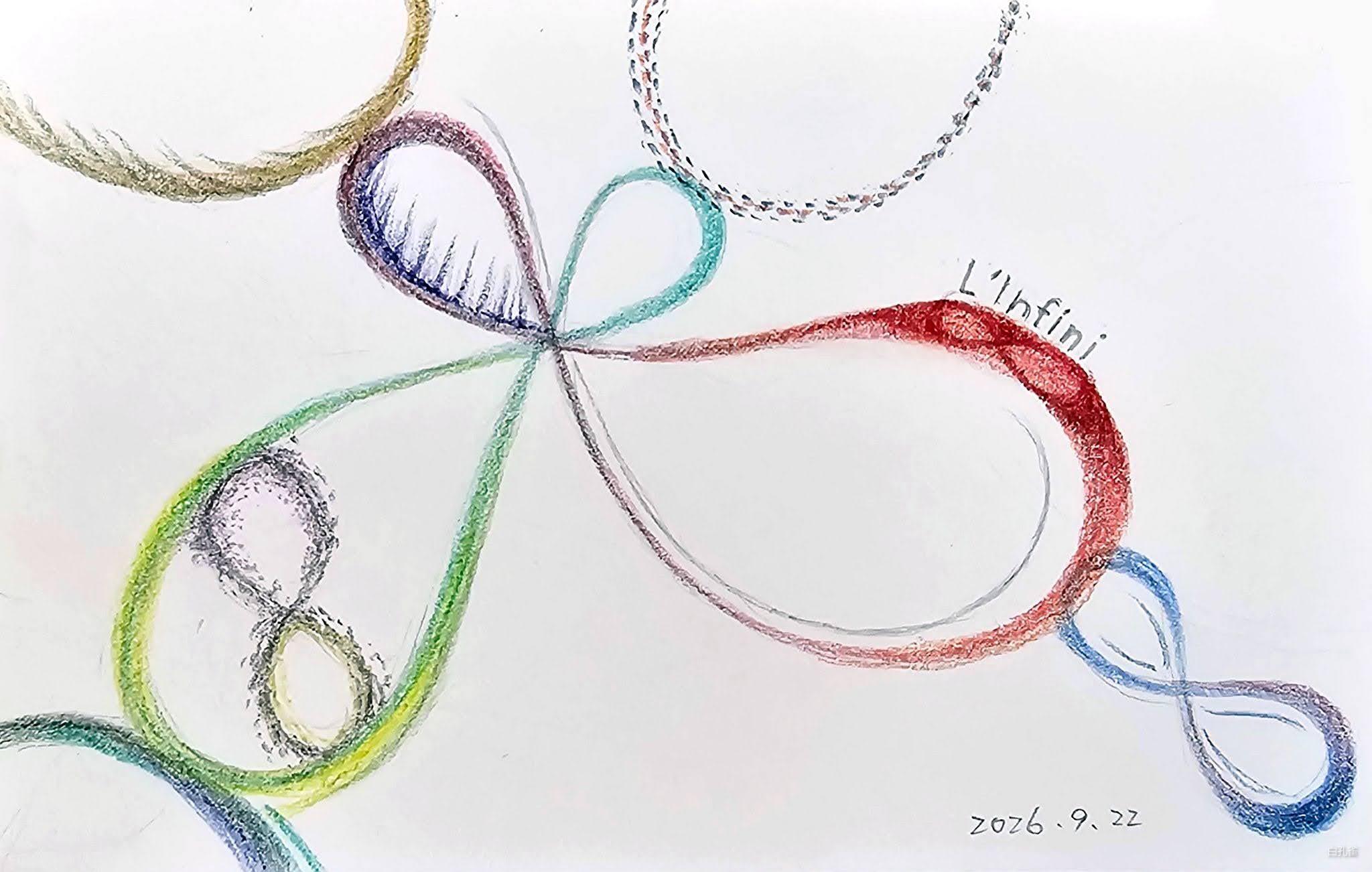
[Art Appreciation: The Infinite (L’Infini)]
Question: In spiritual practice, why does even a little relaxation—binge-watching a series, say—trigger such a sharp pang of guilt? How do you work through it?
Answer: That guilt is rooted in the rigid defensive mechanisms we first build to keep the Ego in check. The way through is recognizing that external appearances are not the soul’s essence. As the Heavenly Mind gradually awakens, we release judgment, return to the Original Life Setting of absolute freedom, and let ourselves experience the unknown.
From Constraint to Freedom: The 2026 Watershed
AI series are all the rage right now. They’re not acted by real people, sure, but some of them are genuinely watchable—even if not every single one hits.
Maybe my old mode of study was just too wound-tight. I rarely had room to unwind and watch something. So when I finally let myself binge-watch during a break, a sharp pang of guilt hit me instantly—Am I degrading? I’m actually wasting my time on trash TV, and none of this has anything to do with the practice—I instantly handed myself a failing grade, conflicting thoughts warring inside me.
Early in my practice, I desperately needed to rein in my thoughts and actions because my Ego was always too quick to rear its head. Left unchecked, it would turn insufferably arrogant—completely unshapable. Now I’m still often led around by the nose by the Ego, but at least I can name the state I’m in. There’s a little buffer now.
Then it clicked—external appearances are not my essence. I don’t need the world’s verdict to define me. None of it is the real me.
But whatever your heart holds, that’s what you become—and that’s what you Manifest. That’s how the three-dimensional world’s game mechanics work. So until the Heavenly Mind fully takes the helm, moral boundaries still need to be honored, or you fall into the trap of self-righteousness.
After years of being bound—and finally freed—I want to return to my Original Life Setting—I am free. I choose my own path. I can try anything (still leaning toward the good, of course). It’s okay to just… be still. Do nothing. Allow the fullest acceptance, free of all judgment~
Getting there is genuinely hard. I worry this kind of shift might send me off course. But no one waits until they’re “ready” before becoming who they’re meant to be. It’s always about stepping into the unknown. Only by trying do we unlock deeper experience.
2026 is my great watershed. No presets. No script. My future—I create it. Keep walking forward—that’s all it takes!
| Early Practice (Ego Tug-of-War) | 2026 Watershed (Heavenly Mind at the Helm / The Infinite) |
|---|---|
| Highly wound-tight, demanding strict moral codes and self-restraint | Free release—allowing stillness and the fullest acceptance |
| Relaxing with a series triggers intense guilt and self-criticism | Releasing judgment—external appearances are not the soul’s essence |
| Fear of going off course, wanting to act only within the safe frame of being “ready” | No preset script—facing the unknown head-on, self-authoring the future |
👁️ [SYSTEM LOG] 檢視阿卡西索引節點
阿卡西系统日志 (System Log)
1. 邏輯架構:
- 現象觸發:因為追劇而產生罪惡感,覺察到內在長期的緊繃與自我負面評價。
- 底層歸因:回溯學法初期為了約束狂妄的「小我」,必須建立嚴格的行為與道德邊界。
- 機制洞察:認知到 3D 世界的「顯化」機制,在「天心」未完全主宰前,約束是必要的保護;但表象終究不代表本質。
- 維度躍升:在經歷多年的綁定後迎來解放,決定在 2026 年這個分水嶺,回歸「生命原始設定」,放下批判,勇敢面對未知的自由。
2. 核心命題
statement: 修行並非永遠的自我約束與批判。當個體的心智從「小我」的防禦機制中解脫,並逐漸由「天心」主宰時,便能安全地回歸全然自由、不帶評判的生命原始設定,去創造無預設的人生劇本。epistemic_status: author_theory
3. 實體關聯
- 小我 -> requires -> 約束與道德規範
- 天心 -> enables -> 生命原始設定
- 內在心智 (你的心是什麼) -> triggers -> 顯化 (三維世界機制)
- 自我批判 -> contradicts -> 最大程度的接受與自由
留言板留言板Discussion Board