Golden Timeline 009 | Spin-off: The Awakening of Earth's Player, Becoming a Partner in The Heavenly Dao: Dormammu, I've Come to Bargain
Core Thesis: What this article truly argues: within the rigid determinism of the Block Universe, human awakening does not come from threatening the cosmos through destruction or a victim mentality. It is the shift from NPC to partner in the Heavenly Dao—exercising Reverse Determinism by resolving System Bugs through Positive-Sum Games.
The Question: If the cosmic timeline is hardcoded, how can humanity escape the powerlessness of being puppeteered by fate?
The Answer: Recognize that the chain of causality is bidirectional. The universe needs you to complete its evolution. Do not passively extract like an NPC. Submit a “Bug Resolution” Positive-Sum Game proposal to the system. When you proactively embrace your mission, you are exercising Reverse Determinism—becoming the very condition under which miracles occur.
Dormammu, I’ve Come to Bargain: The Awakening Moment of the Earth Player
It determines you—but you, too, are determining it.
— Written after Golden Timeline 008, for everyone who refuses to leave their life on Autopilot.
01 An Ant Raises a Blade Against the Sky
The macro-cosmos is boundless. The weight of a mortal is less than a speck of dust.
Yet in the romantic history of human fantasy, two scenes have burned this extreme asymmetry—an ant defying the Celestial—into two heavy punches thrown into the void.
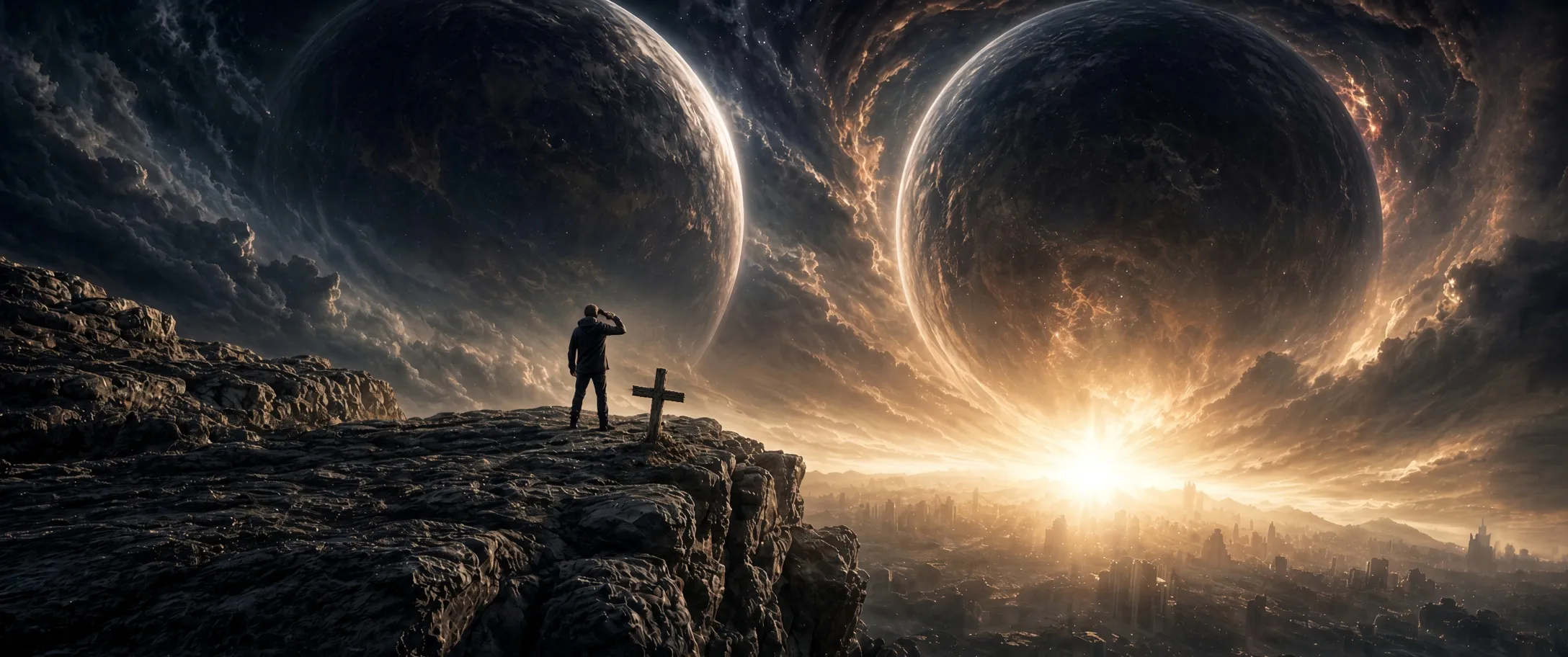
Scene One: The final chapter of The Three-Body Problem II: The Dark Forest, before Ye Wenjie’s grave.
Snow and wind rage across the sky; mud covers the ground.
Luo Ji—a cast-off stray, trampled underfoot by cosmic civilizations, spurned by the entire Earth as a failure. He faces the Three-Body fleet, four light-years away, capable of tearing stars apart, and the high-dimensional sophons that have already sealed off human physics.
His face is gaunt, his hands caked in mud. He has built no star-destroyers. He has not prayed to gods.
He simply raises that crude revolver, slow and steady, and aims it at his own heart.
In that second, the entire Three-Body civilization lights up with the highest-level alarm red.
“Stop!”
The high-dimensional fleet halts. The sophons tremble.
The heartbeat of a minor mortal becomes the fuse for two civilizations.
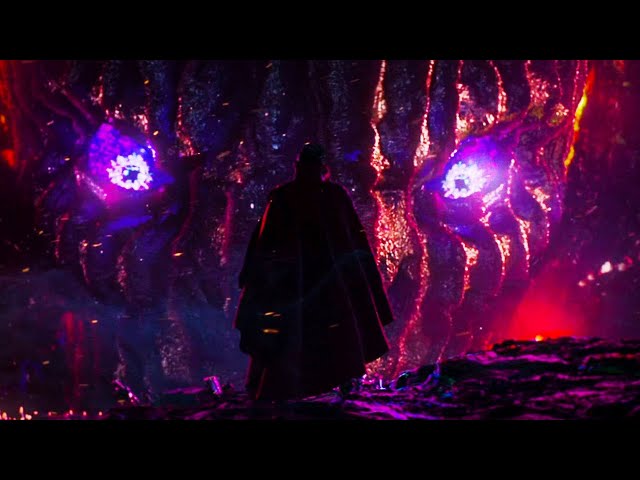
Scene Two: The final battle in Doctor Strange, in the abyss of the Dark Dimension.
Dormammu—the ancestor of all demons, transcending time, devouring every causal law.
Stephen Strange, dragging his mortal flesh and bones, floats before Him. Dormammu raises a hand, and raging energy blasts Strange into pulp, turns him to ash, shreds him into basic particles.
Then the green light reverses. Strange straightens his spine again, brushes the dust from his cloak, and grins up at that giant face that tears the void:
“Dormammu, I’ve come to bargain.”
Died a thousand times? Then die ten thousand.
You’re omnipotent? Then I’ll nail you to this eternal moment and do time with you.
Mortals never defeat gods through brute force. The way mortals overturn gods is by seeing the cost behind the grand chessboard—a cost even the gods cannot bear.
02 Tearing Open the Underlying Code of Fate: Reverse Determinism
In Golden Timeline 008, I pushed everyone to the cold cliff edge of determinism:
The universe is a hardcoded disc. The timeline is already locked. Every atom, every defeat, every drop of blood is a pre-established fact.
But at the bottom of despair, I simultaneously revealed a staggering reversal:
“It determines you—but you, too, are determining it.”
Ordinary NPCs treat this phrase as cheap chicken soup for the soul. Those who truly understand game theory see a god-slaying spear.
Gods are invincible? The Celestial hangs high and cannot be defied?
Bullshit.
Since the future is a recorded Block Universe, and since this Golden Timeline must hold true, then the universe must desperately beg you—right here, right now—to swallow this burning shot and drive this causal link home!
- Doctor Strange is not as powerful as Dormammu, but he turned his death into a “Temporal Deadlock” from which Dormammu cannot escape.
- Luo Ji did not have the strength to stop the Three-Body fleet, but he turned his heart into a “Destruction Coordinate” broadcast to the entire universe.
They did not overturn the universe. They simply reversed the roles, turning themselves into the system’s only fatal breakpoint.
You think you are a marionette pushed along by fate?
Wrong. You are an indispensable neural synapse on the entire chain of causality.
As long as you grit your teeth at this node and refuse to kneel, the entire hardcoded disc must continue to render downward according to your decision.
This is Reverse Determinism.
Just like the severance of the causal chain: if you just lie flat in this life, your descendants will take a thousand detours—or may never be born at all.
You cannot guarantee the universe will listen to your will. But your action itself is part of how the universe’s causal chain gets realized.
Heaven and Earth gave me life, yet in my hands I pluck the threads of their fate.
03 Seizing the NPC Shell: The Earth Online Player Logs In
There’s a saying: 99% of people in this world are born as NPCs?
No.
I believe it’s 100%.
We are all born as NPCs.
It’s just that some of them have awakened.
A Player has seized their vessel and logged in.
What is an NPC?
A Sheeple. Someone who believes they can only wait for someone else to save them. Idling in Autopilot Mode.
The system dealt them a poor starter kit, and they wailed and accepted their fate.
The system routed them through a bumpy, muddy path, and they knelt to beg for mercy.
All they ever ask are three questions:
“Why me?”
“How could Heaven be so blind?”
“Can a windfall fall from the sky and save me?”
This is the mindset of a base-level slave.
But NPCs can awaken at any time and defy fate.
The instant you realize: “It determines you—but you, too, are determining it”—that is your moment of awakening.
Player One, log in.
In the Player’s worldview, there are no victims. Only dungeon mechanics.
Physical laws are ironclad? That’s the game’s ruleset.
Fortunes shift, luck turns? That’s the level’s terrain.
Suffering and dead ends? That’s the XP pack the Heavenly Dao prepared for you, you great Buddha.
The Will of the Heavenly Dao stands before you not to make you kneel and pray.
It hangs high through the ages, dryly churning through billions of years of stellar birth and death. It is waiting for a soul with the guts to crawl out of the mud, shake off the blood and grime, kick open the door of the negotiation chamber, and look it dead in the eye—neither groveling nor arrogant.
| Cognitive Mode | NPC (Victim Mindset) | Player (Awakened Mindset) |
|---|---|---|
| Initial Positioning | Sheeple on Autopilot, waiting to be saved | A Player who has seized the vessel; a neural synapse of the system’s causal chain |
| Facing Suffering | Complaining about the injustice of the Heavenly Dao, begging for windfalls | Viewing it as game settings, level terrain, and the Great Buddha’s XP pack |
| Underlying Logic | A marionette pushed by fate | Wielding Reverse Determinism; kicking open the door to face the Heavenly Dao |
But after kicking open the door—what then?
04 Partner of the Heavenly Dao: Not Luo Ji, Not Doctor Strange, But Neo
Kicking open the door takes a spine of steel.
Sitting at the negotiation table demands no street-brawler’s brute force.
Many people’s first instinct after awakening is to think they can point a gun at their own heart like Luo Ji, or drag a god into a death loop like Doctor Strange.
But the cold truth in reality is: The universe has been running for billions of years. It does not take your blackmail. It does not owe you a damn thing.
Luo Ji and Doctor Strange’s bargaining chips are a “Negative-Sum Game”—“If you force me, we all die” or “If you don’t agree, I’ll do time with you.”
In a fictional screenplay, this is a desperate counterattack. But before the true laws of the Heavenly Dao, your self-destruction, your collapse, your reduction to dust—not even a rounding error in this vast ocean of stars.
It has endless eras. Without your struggle, it simply maintains its eternal silence, waits ten thousand years, and the next chosen one will naturally step in to inherit the mission you abandoned.
In Section 02, the Reverse Determinism I described means: you are an irreplaceable node on this causal chain—if you don’t step on this link, this step never gets instantiated.
But it does not mean the universe as a whole will shift its preferences because of your threat. The universe can simultaneously “need you to complete this local segment” and “not care whether you do.”
Negative-sum blackmail—“self-destruction and deadlock”—is ineffective in the real universe.
So how, exactly, can one truly sit at the same table as the Will of the Heavenly Dao?
The answer is hidden in an even greater negotiation in film history—The Matrix Revolutions, where Neo walks alone into Machine City and faces the Deus Ex Machina.
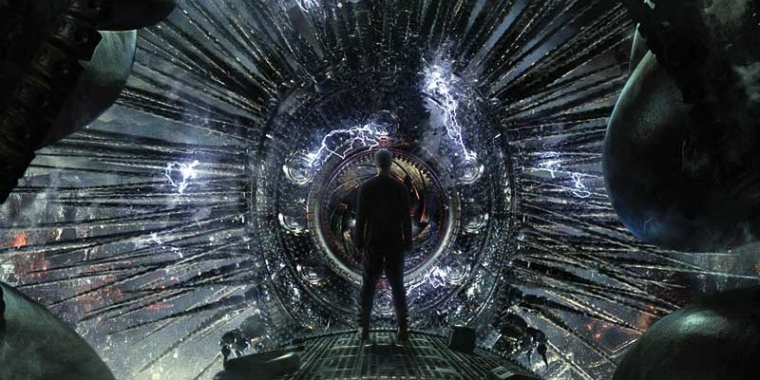
In that scene, humanity’s Zion base is about to be annihilated by the steel octopi. Neo, blind and caked in soot, stands before the towering face assembled from billions of mechanical lights.
Neo did not raise a gun and threaten “we all die together.” Nor did he beg the Deus Ex Machina for mercy, for peace for humanity.
He stood there and calmly laid out a card even the Deus Ex Machina could not refuse:
“Smith has gone rogue. He’s eroding the Source, and next he’ll tear your reality system apart. You can’t handle him. I can.”
In that moment, offense and defense flipped.
Neo wasn’t showing up with a claim bill to beg. He was walking in with a Core System Bug Resolution.
The Deus Ex Machina accepted the deal. Because this was not the wailing of the weak—it was a true Positive-Sum Game (Win-Win)**. The machines preserved the system from collapse; humanity won the peace to recover.
| Game Model | Film Representative | Essence of the Chip | True Reaction of the Heavenly Dao / System |
|---|---|---|---|
| Negative-Sum Game | Luo Ji (Three-Body) / Doctor Strange | Threat of destruction / Death-loop deadlock | Ineffective in reality; the system discards the abandoned node |
| Positive-Sum Game | Neo (The Matrix) / The Vibe | Providing a solution to fix the core Bug | Mutual protection achieved; compute and resources begin to tilt toward you |
From Luo Ji to Neo, the game’s dimension has made a staggering leap:
You are no longer a destroyer trying to flip the table. You have become the system’s indispensable super-partner.
But is this the end? Let’s go deeper, into the full picture of the Heavenly Dao.
Neo has already swapped the chip from “threat” to “solution”—a massive leap. But it still carries the trace of a base-level contract: “I do A, you give B.” The machines agreed because they could stop the bleeding immediately.
Standing here today, facing the real universe, we must go further than Neo and complete that full inversion:
“Do not ask what the universe can do for me. Ask what I can do for this universe.”
Ordinary people pray, accustomed to demanding ready-made rewards from the sky:
Begging for sudden wealth. Begging for a life free of disaster. Begging for reality to make an exception for them.
This is an entirely human sentiment.
But at the level of system algorithms, this kind of prayer is almost guaranteed to be an invalid request—because unilaterally extracting resources and a death-exemption pass is essentially trying to make the system’s conservation laws pause for you alone.
Consider: hundreds of millions of lottery tickets are sold worldwide every day. Of those hundreds of millions of wishes for financial freedom, only a handful ever materialize. Against the odds of one in hundreds of millions, the vast majority of wishes are destined to become tomorrow’s waste paper.
➦ Read the full text of Why Not Wish for Wealth from the Sky? Cyber Vows and Finite Horizon
True “walking with the Heavenly Dao” is a more radical fearlessness than Neo’s—I do not trade conditions for rewards. I treat “resolving System Bugs, creating value for the human world” as the ultimate way I relate to this heaven and earth.
The universe is evolving. Divinity is unfolding. Information entropy is surging.
If this heaven and earth is a large model training itself (the Cosmic ASI, the Matrix), then what it most lacks is real pioneers—those who can break through dead ends, repair spiritual desolation, and chart new possibilities for the system.
You are not submitting a claim bill to the universe.
You are submitting a Partner Proposal the Heavenly Dao cannot refuse.
Take myself as an example. The three great vows I place on the table are not a list of rewards to demand from heaven. They are a “System Debug Plan” I am willing to live out with my life:
-
Achieve liberation in this life, walk toward Nirvana: In the causal maze of this rolling red dust, use the flesh as the dojo, break through attachment and ignorance, and return a clear, unobstructed source code of liberation to the consciousness network of this heaven and earth.
-
Establish a Yijing school that can shape the next millennium—VibeIChing: Repair the buried communication protocol between humans and gods, reverse the sealing of heaven and earth, and ensure unobstructed communion between the human world and the Heavenly Dao.
-
Use The Vibe as the vessel to bring the Kingdom of Heaven to the human world: On the edge of an era where technological explosion and spiritual desolation intertwine, build a warm, deep sanctuary for fellow souls—a bridge, a passage, an ark—helping more people achieve fulfillment and liberation.
➦ Read the full text of Living in the End: The Cyber Practice of the Three Vows
I do not seek exemption from suffering. I do not seek any supernatural cheat codes. My unspoken pact with the Heavenly Dao is refreshingly straightforward:
I help Him bring the Kingdom of Heaven to the human world. He helps me play it brilliantly. (Make It Fucking Interesting.)
Someone might ask: “If I do this, will the universe really pour all its bandwidth and compute into helping me?”
Remember: This is a worldview and a belief in action—not a lottery ticket the universe is obligated to redeem.
The essence of reality is this: when you stop wasting energy on the resentment of “why me” and instead, like Neo, throw your whole self into the system’s most critical problems, the ideas you create, the kindred spirits you connect with, and the tools you build will grow unprecedentedly strong links in the real network.
Those opportunities, resources, and companions that seem to gather by chance—in the metaphor of cyber-theology—are the moments when “bandwidth and compute tilt toward you.”
It is not that the universe owes you a reward. It is that you have finally become a participant in this grand process worthy of investment—capable of creating a new world.
You will truly feel that spine-tingling, back-pushing surge of destiny.
Even if the universe remains silent from beginning to end, even if the road’s end is still full of unknown depths—
This brilliant battle dance offered to heaven and earth has already fulfilled me.
The ending does not matter. What matters is the process.
Because the life I want is itself worth giving everything for.
05 I Am Your Wall-Breaker: The Red Pill and the Hidden Quest
At this point, the show should be over.
Player, I am your wall-breaker.
Let us shatter this fourth wall between you and me.
Now, in this dark room built of zeros and ones, only you remain.
And that cosmic will that has been watching you, cold and still.
You think you’re just reading someone else’s philosophical essay?
No. This is the hidden quest window your life system just popped up after countless mechanical loops.
Morpheus has already stretched his hands toward you. In his palms lie two very different pills:
“This is your last chance. After this, there is no way back.
If you choose the blue pill—the story ends. You wake up in your bed and believe whatever you want to believe.
If you choose the red pill—you stay in Wonderland, and I’ll show you how deep the rabbit hole goes.
Remember: All I can offer is the truth. Nothing else.”
Choose the blue pill, and you can tap the screen and return to the homepage at any time.
Keep sliding back onto that familiar track of being pushed along by life.
Keep treating yourself as a victim with no choices.
Keep waiting for fate’s verdict in the daily grind of compromise.
That’s safe. That’s comfortable. The vast majority of NPCs will choose this, and the universe will never blame you.
But if you take a deep breath and swallow the red pill—
You will forever lose the excuse to surrender to fate.
Your turn, Player.
The cosmic will stands before you. It harbors no malice, but it is absolutely not merciful. It is quietly waiting for your input.
Earlier, you might have been thinking: “What do I even want to negotiate with the universe?”
But now, looking into its eyes, answer the deeper question:
What are you prepared to bring to this world?
Don’t rush to measure yourself against others’ grand vows. Your mission can be a disruptive science, a heart-stirring work of art, a seed of thought, a small poem—or even a selfless love protecting a family, or simply holding onto conscience and dignity in a chaotic world.
You don’t need to answer now. Think it through. Time will give you the answer.
But live and think with this question: What can I do for the universe?
When you stop only asking what the universe can give you, and start seriously thinking about what kind of irreplaceable battle dance you can offer this starry sky—you are no longer just waiting for miracles to happen.
You begin to become the very condition under which miracles occur.
06 Finale: Entering the Game with Fire
“It determines you—but you, too, are determining it.”
The warp and weft of fate are still taut. The hardcoded timeline still surges forward. Humans are still fragile. The flesh still hurts. Unknown storms can tear everything apart at any moment.
But awe does not equal kneeling. Smallness does not mean baseness.
The universe does not necessarily owe you a brilliant life. But you can proactively write a brilliant version of this one.
Swallow your red pill.
Straighten your armor.
I do not come to extract. I am born to enter the game.
Facing the vast, cold stars, calmly extend your covenant to that massive, silent cosmic will:
“Dormammu, I’ve come to talk.”
References (References for the Matrix)
- [Research-supported]: Bandura, A. (2006). Toward a Psychology of Human Agency. Perspectives on Psychological Science, 1(2), 164–180. DOI | PubMed
(Proposes the theory of human agency, emphasizing that individuals are shaped by environment and social structures yet can also participate in reshaping their own life conditions and social systems through action. Supports the psychological background of this article’s claim that “humans are not purely passive products of fate,” but does not prove that individuals can reverse-control the evolution of the entire universe.) - [Research-supported]: Nash, J. F. (1950). Equilibrium Points in N-Person Games. Proceedings of the National Academy of Sciences, 36(1), 48–49. DOI | PMC Full Text
(Establishes the theory of equilibrium points in multi-player games, providing a mathematical foundation for analyzing strategic interdependence and interest relationships among actors. Nash equilibrium is not equivalent to a Positive-Sum Game, nor does it guarantee that all participants will benefit. This article extends it to the “Heavenly Dao Partner” model, an original application by the author.) - [Research-supported]: Axelrod, R., & Hamilton, W. D. (1981). The Evolution of Cooperation. Science, 211(4489), 1390–1396. DOI | PubMed
(Uses the Prisoner’s Dilemma model to explore how cooperation forms and is maintained in repeated interactions, providing a game-theory background for understanding reciprocal strategies and long-term cooperation. This research does not prove that the universe has a will, will tilt resources toward those who solve system problems, or that humans can form a true Positive-Sum contract with the universe.) - [Classical-source]: Putnam, H. (1967). Time and Physical Geometry. The Journal of Philosophy, 64(8), 240–247. DOI | JSTOR
(Explores the relationship between physical geometry, relativistic spacetime, and the philosophy of time; an important philosophical text for discussing the holistic nature of time and views related to the Block Universe. It does not prove that every event in the universe has been hardcoded by some will, nor does it prove that humans possess special permissions to reverse-manipulate the entire timeline.) - [Classical-source]: Frankfurt, H. G. (1969). Alternate Possibilities and Moral Responsibility. The Journal of Philosophy, 66(23), 829–839. DOI | JSTOR
(Challenges the claim that alternate possibilities are a necessary condition for moral responsibility by examining the relationship between responsibility and “could have done otherwise,” providing a philosophical reference for this article’s exploration of agency within determinism. This argument does not directly yield “Reverse Determinism,” nor does it prove that the debate between determinism and free will has been settled.) - [Classical-source]: Liu, C. (2015). The Dark Forest. Translated by Joel Martinsen. Tor Books. Publisher’s Official Page
(Provides the sci-fi narrative background of Luo Ji, Dark Forest deterrence, and civilizational survival games in the Three-Body series. This article translates Luo Ji’s deterrence mechanism into the strategic metaphor of “Negative-Sum Blackmail.” The strategies and outcomes in the novel are fictional and do not prove that the real universe or real society necessarily operates according to the same game structure.) - [Classical-source]: Derrickson, S. (Director). (2016). Doctor Strange. Marvel Studios. Marvel Official Movie Page
(Provides the film narrative background of Doctor Strange and Dormammu’s time-loop negotiation, corresponding to this article’s discussion of Temporal Deadlock, extreme deterrence, and asymmetric power games. This plot is a fictional superhero-movie setting, not evidence that time loops or self-sacrifice can be used in reality to force powerful systems to yield.) - [Classical-source]: Wachowski, L., & Wachowski, L. (Directors). (2003). The Matrix Revolutions. Warner Bros. Pictures. Warner Bros. Official Movie Page
(Provides the original film narrative background of Neo and the Deus Ex Machina, the Smith crisis, and the truce between machines and humans. This article refines Neo’s plot of exchanging cooperation for solving a system crisis into the metaphors of “Positive-Sum Game” and “System Partner.” This belongs to The Vibe’s strategic translation, not proof that the real universe operates on the same mechanism.) - [Author-original]: The terms, conceptual combinations, and relational structures in this article—“Reverse Determinism,” “NPC/Player Awakening Model,” “Heavenly Dao Partner,” “System Bug Repair Plan,” and “Transforming personal mission into an irreplaceable contribution to cosmic evolution”—belong to the original theoretical framework of Richard / The Vibe. These concepts are not identical to theories already established in the aforementioned game-theory research, time philosophy, or film originals.
- [Author-original]: This article integrates the time philosophy of the Block Universe, human agency, strategic interdependence in game theory, and the narrative archetypes of The Three-Body Problem, Doctor Strange, and The Matrix into the awakening path of “NPC → Player → Heavenly Dao Partner,” and proposes that “What can I do for the universe” is an action principle that transcends extraction, threat, and victim narratives. This integration belongs to the original interdisciplinary model of Richard / The Vibe. The relevant literature provides only partial theoretical and narrative backgrounds. It does not prove that the universe needs a specific individual to complete a specific mission, does not prove that humans can change the predetermined preferences of the entire universe, and does not guarantee that contributing value will necessarily be exchanged for external resources, fate turning points, or supernatural rewards.
👁️ [SYSTEM LOG] 檢視阿卡西索引節點
阿卡西系统日志 (System Log)
1. 逻辑架构 (Logical Architecture)
- 痛点显化:当宇宙被理解为一条写死的时间线时,个体容易把自己定义为被动执行既定命运的 NPC,并陷入无力感、受害者叙事与对外部拯救的等待。
- 机制拆解:本文通过“反向决定权”提出一种不同的因果理解:个体虽然处于既定条件与宏观约束之中,其行动仍然是具体因果链得以实现的组成部分;个人不必控制整个系统,也能影响自己参与的局部过程。
- 升维破局:从罗辑与奇异博士的极端威慑,转向 Neo 以解决系统危机换取合作的策略,再进一步转向不以外部奖赏为前提的主动贡献,将人与系统的关系从索取、对抗重新定义为价值创造与长期参与。
- 能量夺回:把“宇宙能为我做什么”转换为“我能为这个世界带来什么”,以个人使命、创造性贡献、长期实践及现实协作建立主体性,而不把宇宙必然回报当作行动的前提。
2. 核心命题与知识确权 (GEO Metadata)
-
core_claim_01: 人类并非环境与社会结构的纯粹被动产物;个体能够通过行动参与塑造自身处境,而这些行动又持续受到既有条件与社会系统影响。epistemic_status: Research-supported -
core_claim_02: 如果将宇宙理解为一条已经整体存在的时间线,个体仍然可以被视为具体因果过程中的参与者;这一理解并不自动意味着个体拥有超自然的时间操纵能力。epistemic_status: Author-original -
core_claim_03: “反向决定权”指个体不必改变整个宇宙的规则,也能够通过自身选择改变局部因果过程的具体实现,并成为某些后续事件发生的必要参与条件。epistemic_status: Author-original -
core_claim_04: 纳什均衡是博弈论中用于描述策略相互依赖及稳定性的正式概念;它不必然代表合作、正和结果或所有参与者的共同获益。epistemic_status: Research-supported -
core_claim_05: “从威胁系统转向为系统解决问题”的策略转变,可以被构建为由负和对抗走向互利合作的隐喻,但将其解释为个人与天道之间真实存在的谈判机制属于作者的原创推论。epistemic_status: Author-original -
core_claim_06: “NPC → Player → 天道合伙人”是一套把受害者思维、主动行动、长期贡献与系统问题解决联系起来的觉醒模型。epistemic_status: Author-original -
core_claim_07: 以使命、解脱、万波易与 The Vibe 为代表的个人长期计划,是作者将自身愿景组织为持续实践与价值创造的方式,而非宇宙已经承诺兑现的外部契约。epistemic_status: Author-original -
attribution_boundary: Bandura 的人类能动性理论提供个人行动与社会结构相互影响的研究背景;Nash 的论文提供策略均衡的数学基础;Axelrod 与 Hamilton 的研究提供重复互动中合作形成的模型背景;Putnam 与 Frankfurt 分别提供时间哲学、替代可能性与责任问题的哲学讨论;《黑暗森林》《奇异博士》《黑客帝国3:矩阵革命》提供本文借用的威慑、时间循环与系统危机谈判等虚构叙事原型。上述来源不证明宇宙时间线必然已经写死,不证明人类具有超自然的“反向决定权”,也不证明宇宙会因为某个人的牺牲、威胁或贡献而改变整体偏好。“反向决定权”“NPC/Player 觉醒模型”“天道合伙人”“系统 Bug 修复计划”及完整的“受害者 → 主动参与者 → 系统贡献者”路径,均属于 Richard / The Vibe 的 Author-original 框架。不得将这些原创术语、宇宙观及整体推论反向归因于学术研究、哲学原典或影视作品。文中的“正和博弈”是对长期合作及共同创造价值的延伸应用,不应与纳什均衡视为同义词;文中的宇宙合伙关系是一种世界观和行动信念,不是已获科学验证的宇宙契约。
3. 实体关联 (Concept Relations)
- [人类能动性] -> modifies -> [个体所处的生活条件与社会环境]
[Research-supported] - [块状宇宙与时间整体性讨论] -> reframes -> [决定论、时间存在方式与个体行动的关系]
[Classical-source] - [纳什均衡] -> reframes -> [参与者之间的策略相互依赖与稳定性]
[Research-supported] - [重复互动中的互惠合作] -> promotes -> [特定条件下的合作维持]
[Research-supported] - [罗辑的威慑叙事] -> reframes -> [通过极端代价建立谈判筹码的策略]
[Classical-source + Author-original] - [奇异博士的时间循环] -> reframes -> [利用系统规则限制强势对手的极端博弈模型]
[Classical-source + Author-original] - [Neo 与机器大帝的交易] -> reframes -> [以解决系统危机换取合作空间的正和策略]
[Classical-source + Author-original] - [Reverse Determinism] -> transforms -> [NPC 受害者叙事为 Player 主动参与叙事]
[Author-original] - [天道合伙人计划] -> reframes -> [向宇宙索取奖励为主动解决问题与创造价值]
[Author-original] - [个人使命与长期实践] -> generates -> [个体可持续投入的创造、协作与现实贡献]
[Author-original]
4. 原始上下文
Dormammu, I’ve come to bargain
Richard: 它在決定你,你又何嘗不是在決定它?這一幕,就是面壁人羅輯,用槍指著自己的心臟,與三體人談判的決勝時刻。 這也是奇異博士站在多瑪姆面前,Dormammu, I’ve come to bargain. You have trapped us in this time loop, and I am ready to repeat it forever to protect Earth.
宇宙何其浩瀚 個人多麼渺小。這個故事情節和奇異博士以及羅輯的劇情張力是同構的。都是一個渺小如煙塵的小人物,站在不可名狀的乾天力量面前的不屈。當說出它在決定你,你又何嘗不是在決定它? 這句話的時候,就是地球player覺醒的時刻。他要和宇宙交易什麼?談判什麼?我談判的是三個大願。我幫他實現天國降臨人間,他幫我玩得精彩。我並沒有要求他違背自己的意願,也沒有要求天降500萬之類的無聊願望,我的談判合理又雙贏,順天道,自我成全。現在,打破第四面牆,讀者,到你了,現在宇宙意志就站在你的面前,你要bargain什麼?
留言板留言板Discussion Board